MSc Cybersecurity & Risk Governance (Dual Track)
MSc Cybersecurity & Risk Governance — one admission, a shared core, two named specialisations.
Conferred under the Polish Law on Higher Education with European ECTS Diploma Supplement.
ApplyAcademic Overview
A double-path master's for security professionals who must both defend systems and answer to a board. Shared core in security fundamentals, then pathways in Technical Security (architecture, detection, response) and Risk Governance (frameworks, audit, regulation), closing with a capstone that produces a defensible security programme. No offensive-security coursework. IU International University of Applied Sciences teaches this award to one academic standard whether you study on campus in Warsaw or on the tuition-free online pathway. Assessment is identity-checked; the marking scheme does not change with your postcode. This is an academic Master's award; where a field has a licensing or registration route, that remains a matter for your professional body or regulator. You will work through the material as a practitioner-researcher: applied methods, real or anonymised cases, and a supervised capstone or dissertation as the final component. Faculty mark whether you noticed the constraints a slide deck usually hides. MSc Cybersecurity & Risk Governance (Dual Track) is taught as one award, not a list of unrelated modules. The published length is 24 months, and the credit total is 42. Students move from Security Foundations & Threat Landscape through Security Foundations & Threat Landscape; Identity, Cryptography & Access Control; Enterprise Risk & Control Frameworks; Research Methods & Identity-Checked Assessment; Defensive Architecture & Network Security; Detection Engineering & Security Operations, and finish on Dual-Track Capstone: Defensible Security Programme. Each course has a question, a method, and a submission. In this field, students map one named system, write a threat model, and specify the controls that would stop the most likely path. Reading is control catalogues, incident write-ups, and a short technical standard. The artefact a marker expects is a defensive design with a test plan and a statement of residual risk. The award is built so that a graduate can do the following in practice: Design proportionate security controls for a real organisation Run detection and incident response without heroics or blame Translate technical risk into board-level decisions and reporting Teaching assumes the student can read a source, attempt a problem before the seminar, and revise after feedback. Attendance at live seminars is part of the design. The capstone or final course must use the methods of the earlier courses; a project that ignores them does not pass. The pages for each course name the topics that are examined. Those topics are the syllabus. A brochure line is not a substitute for them.
The degree is awarded directly by IU International University of Applied Sciences, seated in Warsaw, Poland. Studies are conducted in full alignment with Polish and European academic standards.

Curriculum & Core Modules
The curriculum comprises 42 ECTS credits structured across progressive academic modules:
Security Foundations & Threat Landscape
Identity, Cryptography & Access Control
Enterprise Risk & Control Frameworks
Research Methods & Identity-Checked Assessment
Defensive Architecture & Network Security
Detection Engineering & Security Operations
Incident Response & Digital Forensics
Cloud & Application Security
Teaching & Assessment Methodology
Online Pathway
Asynchronous learning via the university LMS, digital library access, faculty-led virtual seminars, and proctored online assessments.
Warsaw Campus Pathway
In-person lectures, tutorial seminars, and laboratory sessions at Prosta 20, Warsaw, with full campus facility access.

Career Trajectories
- Security analyst / SOC analyst
- Security engineer or architect
- GRC and security-governance roles
- Incident responder
- Security manager or CISO track
European Campus & Academic Facilities
Seated at Prosta 20 in Warsaw, IU International University of Applied Sciences offers state-of-the-art academic lecture halls, digital research repositories, and vibrant collegiate spaces for both on-campus and international distance scholars.

Main academic building at Prosta 20, Warsaw.

Collegiate courtyard and research study spaces.
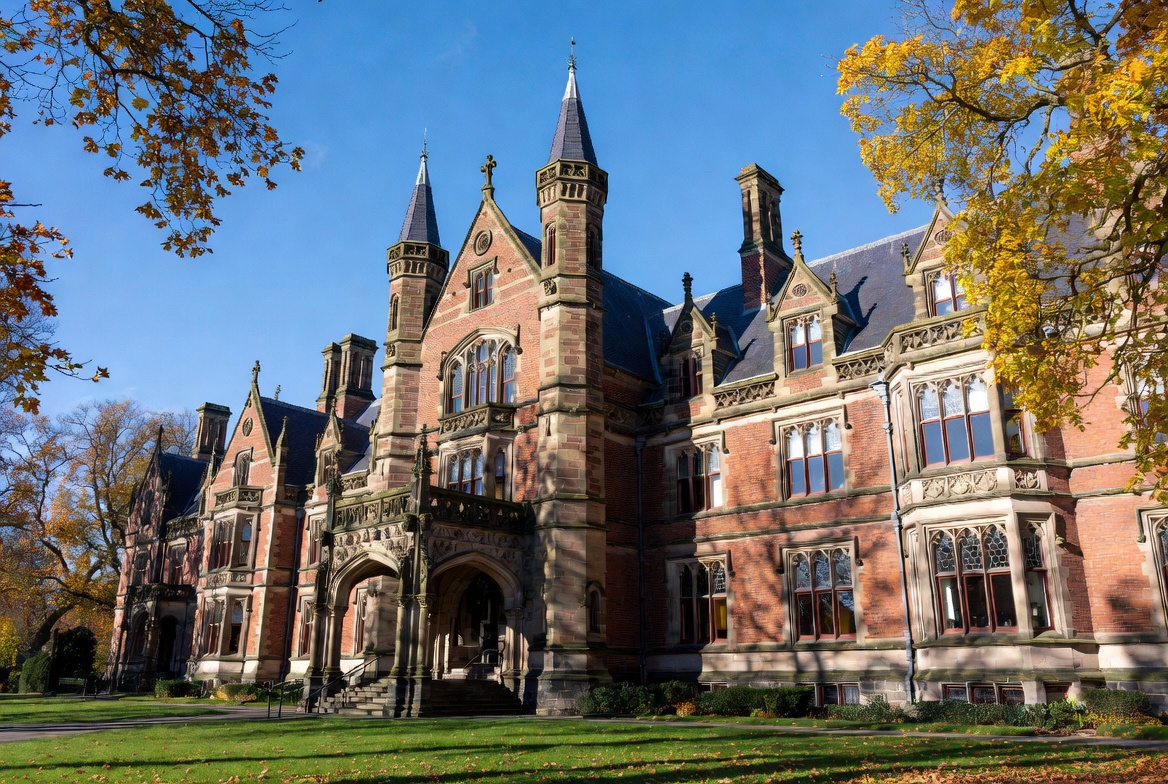
Academic facilities and faculty laboratory suites.

Degree Recognition, NAWA & EDINAC Accreditation
Degrees from IU International University of Applied Sciences are awarded under the statutory framework of the Republic of Poland and the European Bologna Process (ECTS). Qualification transparency and international academic mobility are supported within the framework of NAWA (Polish National Agency for Academic Exchange) and European ENIC-NARIC networks. Furthermore, the university holds Tier 1 Full International Accreditation from EDINAC (Ref: EIAC/QA/PL/2000-IU) with immutable cryptographic diploma verification on edinac.org.